
TAX DOCUMENTS CHECKLIST
This tax documents checklist helps answer one of the most common filing questions: what documents do I need to file my taxes? It walks individuals through the most common information and records typically needed to prepare an accurate federal and state income tax return. While not every taxpayer will need every document listed, organizing your tax paperwork ahead of time can make filing smoother and help reduce delays.
The documents you need to file your taxes depend on your income, household, and financial activity during the year. This guide breaks everything down into clear categories so you know what to gather before starting your return or meeting with a tax professional.
We Can Prepare Your Tax Return
Table of Contents
FREE TAX EDUCATION RESOURCE
Tax Preparation Services Resources & Free Tax Guides
Explore comprehensive tax guides covering hundreds of topics from tax years 2021 through 2026. Designed for individuals, businesses, and nonprofits, these resources help you understand tax laws, deductions, credits, and planning opportunities—so you can make informed decisions with confidence.
List of Tax Documents Needed
This list of tax documents needed gives a broad overview of what most taxpayers should gather before filing. Some documents apply to nearly everyone, while others depend on specific situations like having dependents, owning a home, or earning income outside of a traditional job.
Reviewing a complete list of tax documents early can help reduce last-minute scrambling and ensure nothing important is overlooked.
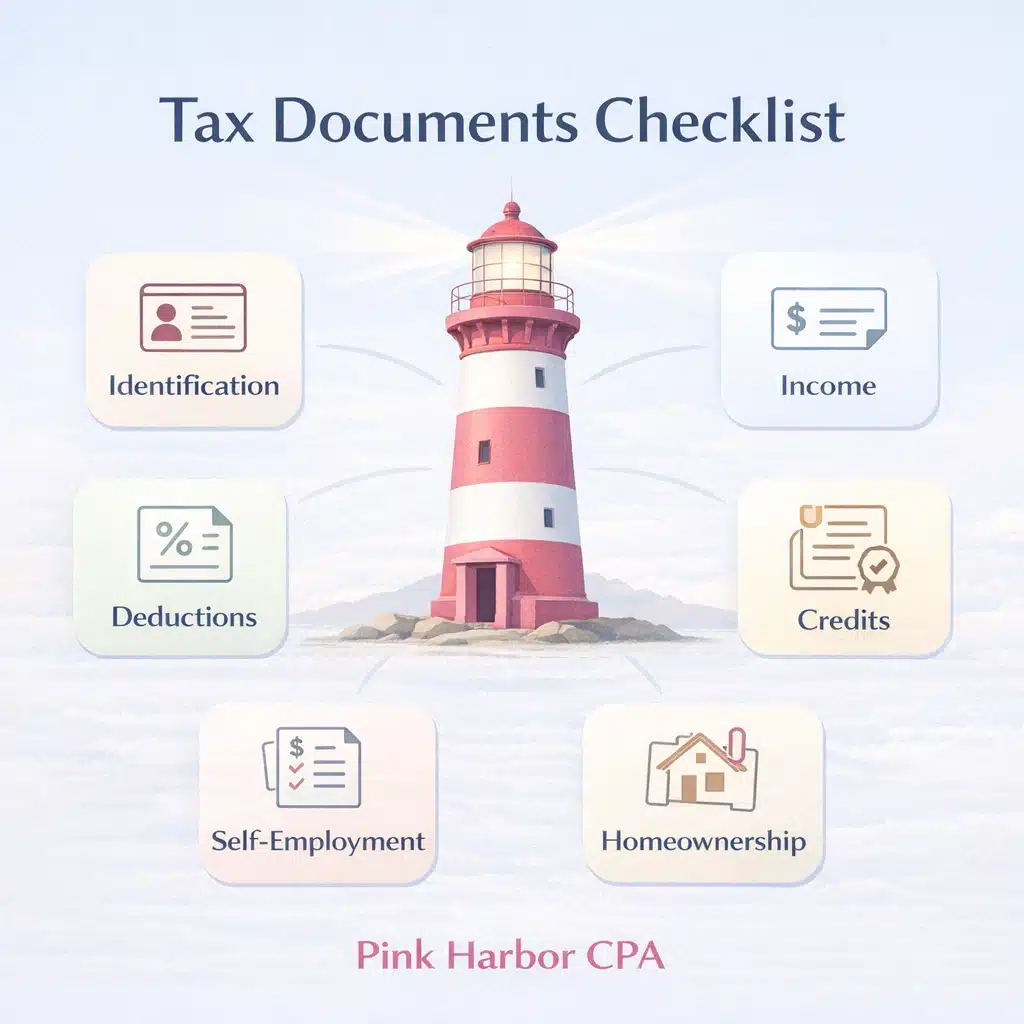
Tax Documents Checklists
Tax Documents Checklist for Identification
The Tax Documents Checklist for Identification covers the basic personal information required to file a tax return accurately. These documents confirm who is filing, who is included on the return, and how the IRS identifies each taxpayer and dependent. A common tax documents checklist for identification is below.
| Social Security Numbers | Dates of Birth | Divers Licenses |
| IRS Identity Protection Pin (IPIN) | Dependent Names | Dependent Social Security Numbers |
| Proof of Residency for Dependents | Banking Information for Direct Deposit of Refund | Form 8332, if a custodial parent released the right to claim a child |
Tax Documents Checklist for Income
The Tax Documents Checklist for Income includes records that show how much income you earned during the tax year and where it came from. These documents are used to report wages, benefits, investment activity, and other taxable earnings. A common tax document checklist for income is below.
| Forms W-2 from employers | Unemployment compensation statements (Form 1099-G) | Pension, IRA, or annuity income statements (Form 1099-R) |
| Social Security or Railroad Retirement benefits statements (SSA-1099 or RRB-1099) | Interest income statements (Form 1099-INT) | Dividend income statements (Form 1099-DIV) |
| Brokerage statements for stock or securities sales (Form 1099-B) | Records of cost or basis for investments sold, if not reported on Form 1099-B | Real estate sale proceeds (Form 1099-S) |
| Gambling or lottery winnings and Losses (Form W-2G & Loss Records) | Hobby income records | K1s From Partnerships, Trusts & Other Businesses |
Tax Documents Checklist for Deductions
The Tax Documents Checklist for Deductions focuses on records that may reduce taxable income, depending on your financial situation. These documents support expenses that may qualify as deductions under current tax rules. A common tax document checklist for deductions is below.
| Vehicle sales tax or personal property tax invoices | Records of state and local income or sales tax paid (other than wage withholding) | Charitable donation receipts for cash contributions |
| Records of non-cash charitable donations | Mileage records for charitable or medical travel | Medical and dental expense records |
| Health insurance premium payment records | Educator classroom expense receipts (K–12 educators) | Student loan interest statements (Form 1098-E) |
Tax Documents Checklist for Tax Credits
The Tax Documents Checklist for Tax Credits applies to documents used to determine eligibility for credits that directly reduce tax owed. These credits are often tied to family, education, or health-related expenses. A common tax documents checklist for tax credits is below.
| Childcare provider name and tax identification number | Records of amounts paid to a daycare center, babysitter or nanny, | Forms 1098-T from eligible educational institutions |
| Receipts itemizing qualified education expenses | Form 1095-A for health insurance purchased through the Health Insurance Marketplace | Electric vehicle purchase information |
| Energy-efficient home improvement receipts | Adoption Related Expenses | Foreign Taxes Paid |
Tax Documents Checklist for Homeowners
The Tax Documents Checklist for Homeowners covers paperwork related to owning, improving, or selling a home during the tax year. Homeownership can affect a tax return in several ways depending on what occurred. A common tax documents checklist for homeowners is below.
| Mortgage interest statements (Form 1098 or other mortgage interest records) | Real estate tax records for your home | Personal property tax records related to your home if paid outside of your real estate taxes |
| Receipts for energy-efficient home improvements (such as solar panels or solar water heaters) | Electric vehicle charging equipment or related home installation records (if applicable) | Purchase, Sale & Capital Imrovement documents if you sold a home during the year (including closing statements) |
Tax Documents Checklist for Self-Employed Individuals
The Tax Documents Checklist for Self-Employed Individuals includes records used to report income and expenses from freelance work, contract work, or business activity. Self-employed taxpayers typically receive income from multiple sources and are responsible for tracking their own records throughout the year. A common tax documents checklist for self-employed individuals is below.
| Forms 1099-NEC and 1099-MISC received from clients | Schedules K-1 reporting partnership or pass-through income | Records of income not reported on a 1099 |
| Payment card or third-party network transaction records (Form 1099-K) | Business income summaries or profit and loss records | Mileage logs for business vehicle use |
| Business-use asset information, including cost and date placed in service | Depreciation records for equipment, vehicles, or other assets | Home office information |
| Phone bills if used for business | Auto related expenses such as repairs, tolls, insurance & parking | Payroll & Sales Tax records |
Filing Taxes In Person or Online with Pink Harbor, CPA
Pink Harbor, CPA helps individuals and families with filing income taxes through both in-person and secure virtual services throughout South Jersey and across New Jersey.. Visit our Williamstown, NJ office for a traditional CPA experience, or work with us remotely using secure portals and video conferencing designed to protect your data and replicate an in-office meeting.
Our location in Williamstown allows us to serve individuals and families in-person who come from nearby towns such as Washington Township, Winslow Township, Berlin, Gloucester Township, Deptford, Glassboro, Monroe Township, Turnersville, Sewell, Sicklerville, Clayton, and Blackwood, as well as across Gloucester County, Camden County, and Atlantic County. Our virtual services extend that same level of care to clients throughout New Jersey.
While many clients prefer visiting our Williamstown office, others choose our secure virtual income tax preparation services. Virtual tax preparation allows New Jersey residents, including those in nearby towns and surrounding counties, to upload documents securely, communicate directly with a CPA, and review and sign their return electronically.
This option is especially helpful for busy professionals, families, retirees, and clients commuting from the Philadelphia area who still want the expertise and accountability of a local South Jersey CPA.
Tax Document Checklist FAQs
If you lost your W-2, you can usually request a copy from your employer. Many employers are able to reissue W-2 forms, either by mail or through an online employee portal.
If you didn’t receive your W-2, start by contacting your employer to confirm it was issued and that your mailing or email information is correct. Some employers provide W-2s electronically, so it may be available online.
If you lost a tax form, such as a W-2 or 1099, the best first step is to contact the company or institution that issued it. Many issuers can provide replacement copies or allow you to download the form from your account.
If you didn’t receive a tax form you expected, contact the payer to confirm whether a form was issued. In some cases, income may still need to be reported even if a form was not required to be sent.
If you receive a W-2 after filing your return, review whether the new information affects your income or tax owed. Additional steps may be needed if the information changes what was originally reported.
If you earned income but didn’t receive a 1099, that income may still need to be reported. Bank statements, payment summaries, or other records can help document what you earned.
In many cases, yes. Employers, payroll providers, banks, and investment firms often make tax documents available through online accounts or secure portals.
If a tax form arrives late, review it carefully before filing or compare it to what you’ve already submitted. Waiting for all expected tax forms can help reduce the need for corrections later. Consult with your CPA or Tax Advisor if an amended return is necessary.