
One Big Beautiful Bill
The One Big Beautiful Bill is a sweeping federal law enacted in July 2025 that permanently reshaped large portions of the U.S. tax code. Formally passed as Public Law 119–21, the legislation combines extensions of prior tax provisions with new individual tax benefits aimed at workers, retirees, and families. Because the One Big Beautiful Bill directly affects income reporting, deductions, and exclusions, understanding how it applies to your personal tax situation is essential.
Table of Contents
FREE TAX EDUCATION RESOURCE
Tax Preparation Services Resources & Free Tax Guides
Explore comprehensive tax guides covering hundreds of topics from tax years 2021 through 2026. Designed for individuals, businesses, and nonprofits, these resources help you understand tax laws, deductions, credits, and planning opportunities—so you can make informed decisions with confidence.
What is the One Big Beautiful Bill Act?
The One Big Beautiful Bill Act is a budget reconciliation law enacted by the 119th Congress and signed into law on July 4, 2025. Its tax provisions are primarily contained in Title VII (Finance) and amend the Internal Revenue Code of 1986. Unlike temporary pandemic-era measures or short-term tax extenders, many of the individual tax changes in the One Big Beautiful Bill are written as permanent or long-term modifications, providing greater certainty for taxpayers.
One Big Beautiful Bill Quick Facts
One Big Beautiful Bill Summary
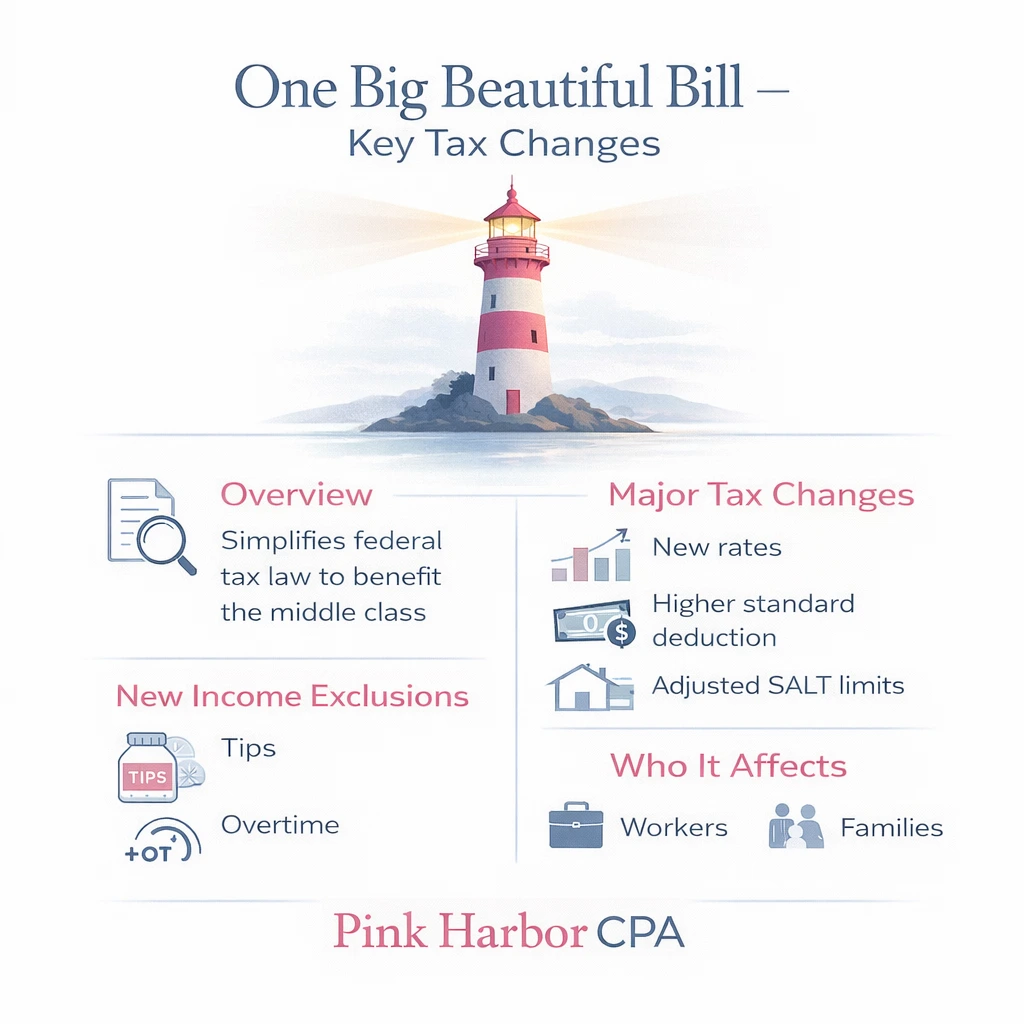
At a high level, the One Big Beautiful Bill extends and enhances reduced individual tax rates, increases the standard deduction, modifies itemized deduction limits, and introduces new exclusions for certain types of income. The law also expands credits for families, establishes new deductions for seniors, and creates income exclusions tied to specific types of work compensation, such as tips and overtime. Together, these provisions significantly alter how taxable income is calculated for many individuals and households.
When Does the One Big Beautiful Bill Go Into Effect?
Most individual income tax provisions in the One Big Beautiful Bill apply beginning with the 2025 tax year, meaning they affect returns filed in 2026. Some provisions reference specific effective dates or transition rules written directly into the statute. Because multiple sections interact with existing tax rules, the practical impact can vary depending on filing status, income level, and sources of income.
What Are the Biggest Tax Law Changes in the One Big Beautiful Bill?
For individual taxpayers, the most significant changes include permanent extensions of lower tax rates, an enhanced standard deduction, and expanded child-related credits. The law also introduces entirely new exclusions from gross income, including exclusions for qualified tip income and certain overtime compensation. In addition, the One Big Beautiful Bill modifies limits on itemized deductions and formalizes a new senior-specific deduction structure, changing how taxable income is calculated for older taxpayers.
What Is the SALT Limitation in the One Big Beautiful Bill?
The One Big Beautiful Bill retains a limitation on the deduction for certain state and local taxes (SALT) as part of its broader restructuring of itemized deductions. While the statute modifies how individual deductions interact with income thresholds, it does not restore an unlimited SALT deduction. Taxpayers who itemize must continue to account for this limitation when determining whether itemizing or taking the standard deduction is more beneficial.
What Is No Tax on Tips in the One Big Beautiful Bill?
Under the One Big Beautiful Bill, qualified tip income is excluded from gross income for federal income tax purposes, subject to limitations. This provision applies to tips received in the course of employment that meet the statutory definition outlined in the law. While excluded from income tax, these amounts may still be relevant for payroll reporting and other tax calculations, depending on individual circumstances.
What Is No Tax on Overtime in the One Big Beautiful Bill?
In addition to tip income, the One Big Beautiful Bill provides an exclusion for qualified overtime compensation, subject to limitations. Overtime pay that meets the law’s requirements is excluded from gross income for income tax purposes. This change directly affects workers who regularly earn overtime wages and alters how total taxable wages are reported on individual returns.
What Is the Enhanced Senior Deduction in the One Big Beautiful Bill?
The One Big Beautiful Bill introduces a temporary senior deduction while formally terminating personal exemptions. This structure provides targeted relief for older taxpayers by allowing an additional deduction amount for eligible seniors, separate from the standard deduction. Eligibility and calculation depend on age and filing status as defined in the statute, making accurate tax preparation especially important for retirees and near-retirees.
One Big Beautiful Bill FAQs
Many of the individual income tax provisions are written as permanent or long-term extensions, though some deductions and exclusions include specific statutory time frames.
No. The One Big Beautiful Bill does not eliminate federal income tax on all tip income. Instead, it creates a limited above-the-line deduction for qualified tips, subject to annual caps, income phaseouts, occupation rules, and an expiration date .
Key details:
Effective for: Taxable years beginning after December 31, 2024 (2025–2028 returns)
Maximum deduction:
Up to $25,000 per year per taxpayer
Income phaseout:
Deduction reduced by $100 for every $1,000 of modified AGI over:
$150,000 (single)
$300,000 (married filing jointly)
Who qualifies:
Only cash tips received in occupations that customarily and regularly received tips on or before December 31, 2024, as determined by Treasury
Important limitations:
Tips must still be reported
Tips are not excluded from payroll taxes (Social Security and Medicare still apply)
Expiration:
The tip deduction terminates after December 31, 2028
Yes. Overtime pay still counts as income, but the law allows a separate deduction for qualified overtime compensation, subject to caps, income limits, and an expiration date .
Key details:
Effective for: Taxable years beginning after December 31, 2024 (2025–2028 returns)
Maximum deduction:
$12,500 per year (single)
$25,000 per year (married filing jointly)
Income phaseout:
Reduced by $100 for every $1,000 of modified AGI over:
$150,000 (single)
$300,000 (married filing jointly)
What qualifies:
Only overtime compensation required under the Fair Labor Standards Act, meaning pay above the regular rate
What does not change:
Overtime wages remain reportable on W-2s
Payroll taxes still apply
Expiration:
The overtime deduction terminates after December 31, 2028
Changes to taxable income and deductions may affect withholding accuracy. Reviewing withholding after major tax law changes is often advisable.
The impact depends on your income sources, age, filing status, and deductions. Many taxpayers will see changes to how taxable income is calculated under the new law.
For individuals navigating these changes, working with a professional who regularly prepares and reviews returns under current federal law can help ensure accuracy. Pink Harbor’s Individual Income Tax Preparation Services support taxpayers in applying new federal tax laws correctly and confidently.
Individual Income Tax Preparation In Person or Online with a Local New Jersey CPA
Pink Harbor, CPA helps individuals and families with individual income tax preparation through both in-person and secure virtual services throughout South Jersey and across New Jersey.. Visit our Williamstown, NJ office for a traditional CPA experience, or work with us remotely using secure portals and video conferencing designed to protect your data and replicate an in-office meeting.
Our location in Williamstown allows us to serve individuals and families in-person who come from nearby towns such as Washington Township, Winslow Township, Berlin, Gloucester Township, Deptford, Glassboro, Monroe Township, Turnersville, Sewell, Sicklerville, Clayton, and Blackwood, as well as across Gloucester County, Camden County, and Atlantic County. Our virtual services extend that same level of care to clients throughout New Jersey.
While many clients prefer visiting our Williamstown office, others choose our secure virtual income tax preparation services. Virtual tax preparation allows New Jersey residents, including those in nearby towns and surrounding counties, to upload documents securely, communicate directly with a CPA, and review and sign their return electronically.
This option is especially helpful for busy professionals, families, retirees, and clients commuting from the Philadelphia area who still want the expertise and accountability of a local South Jersey CPA.
Visit Our Blog Articles Filled With Valuable Information